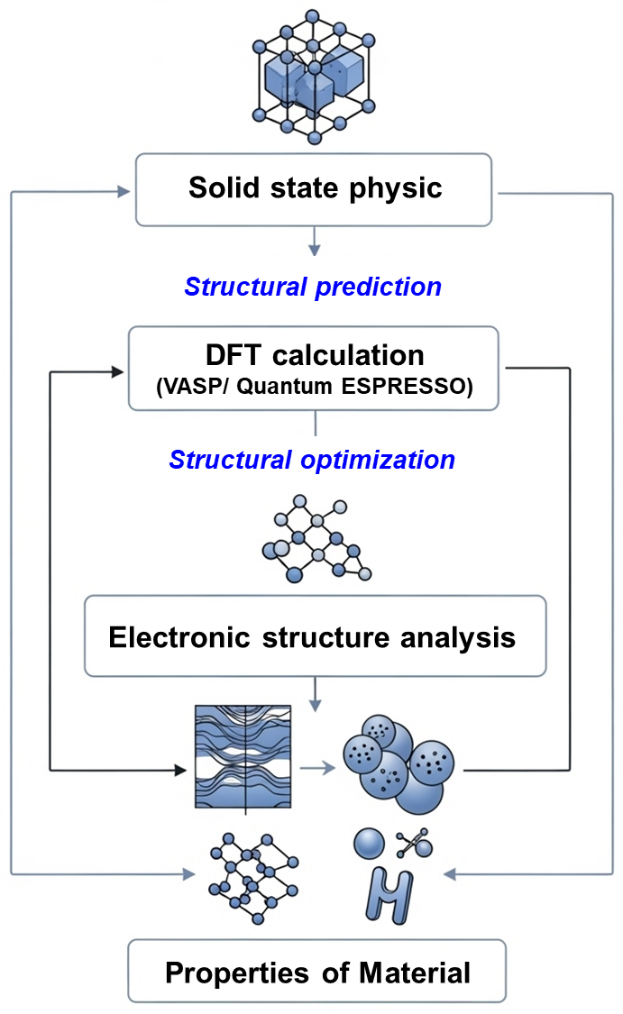
Density Functional Theory (DFT) is a computational method in quantum mechanics used to simulate and study materials at the atomic and molecular level. The basis of this method is based on a clever idea: instead of understanding the properties of materials by solving the very complex Schrödinger equation, an equation that depends on 3N variables, where N is the number of electrons of an atom and the position is represented by 3 coordinates, DFT will understand the properties of materials through a simple variable, the electron density. The electron density, ρ(r), is a function of only three spatial variables, which greatly reduces the complexity of the problem. DFT thus turns an impossible problem into one that can be solved by modern computers, and thus predicts material properties with high accuracy. For these great contributions, Walter Kohn and John Pople were awarded the Nobel Prize in Chemistry in 1998.
DFT is like a "virtual laboratory" that saves time and money. This laboratory helps people predict the properties of materials under simulated conditions before conducting experiments. The power of DFT has wide applications in many fields such as battery manufacturing technology, alloy manufacturing, 2D materials, chemical catalyst materials, etc. For that reason, DFT has become a pillar in research and development, promoting innovation in most high-tech fields.
Currently, our research group uses DFT to simulate and study the atomic structure and electronic structure of magnetic and semiconductor materials, diluted magnetic semiconductor materials, which are the foundation of modern technology. Magnetic materials are used in data storage, while semiconductor materials are the foundation of electronic devices such as computer chips and solar cells. Dilute magnetic semiconductor materials integrate the properties of both magnetic and semiconductor materials, which opens up a potential application in the future.